2. Smart Contract Architecture
This section describes Protocol Guild’s current smart contract architecture. You can learn more about the pilot’s architecture here.
Protocol Guild uses smart contracts created by Splits to trustlessly manage the vesting and distribution of donated funds. All donations are deposited into immutable vesting contracts, which vest funds into pass-through wallets, before being transferred to split contracts for distribution to the membership.
The mainnet split contract also serves as Protocol Guild’s membership registry of Ethereum’s active core protocol contributors. A DAO is used to ratify changes to the membership onchain every quarter.
2.1 Modules
The Guild’s smart contract architecture is modularized as follows:
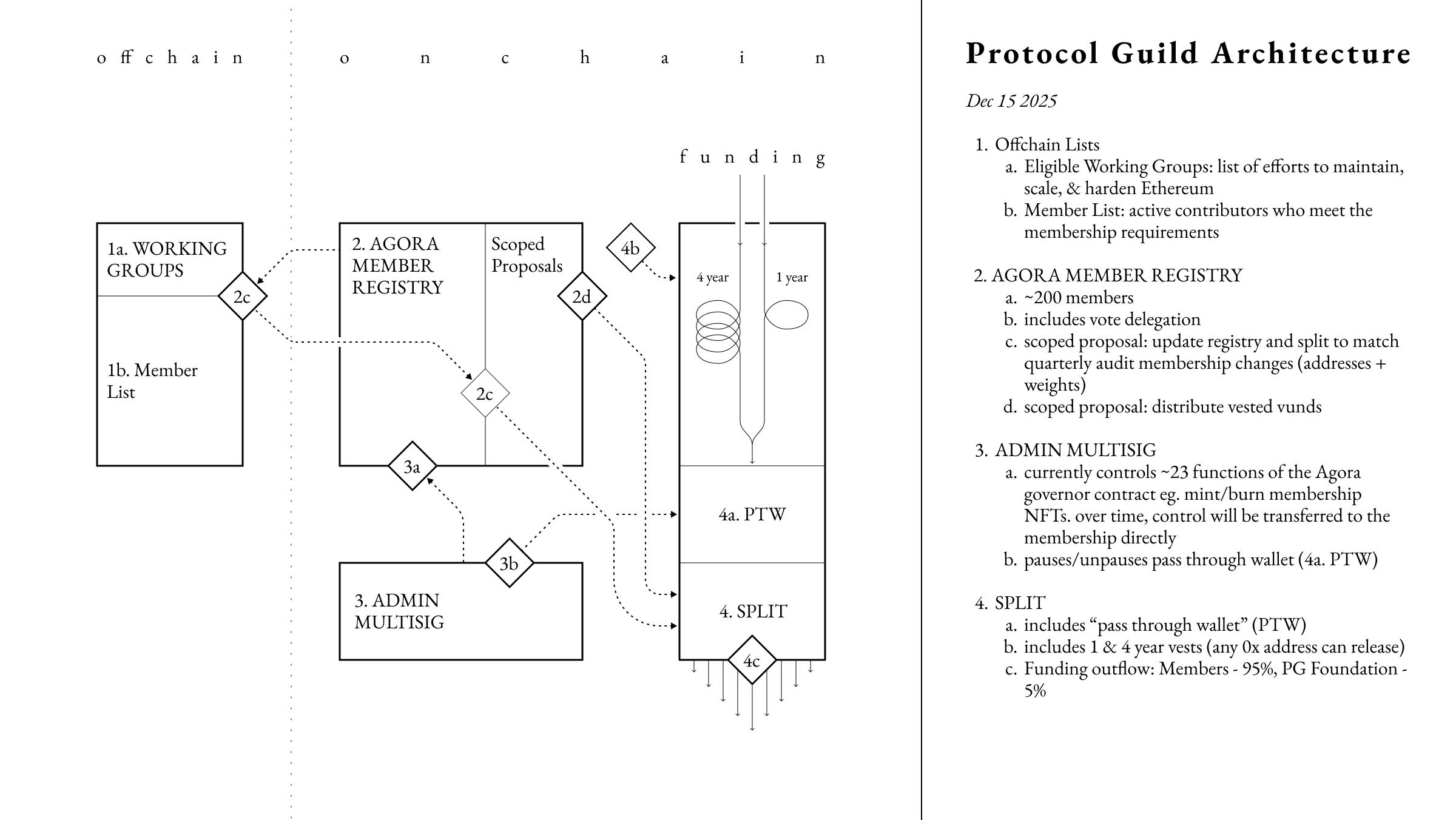
Vesting Contract
The Guild’s donation addresses on Ethereum mainnet, Arbitrum, Base and Optimism are immutable vesting contract, built by the Splits team, which irrevocably vests donated funds on a linear (block-by-block), basis. Here, “irrevocably” means donations cannot be stopped or otherwise redirected during the vest by anyone, be it the donor or Protocol Guild membership. Anyone can donate ETH and ERC-20 tokens to these vesting contracts.
NFT donations are not supported - standard NFT transfers (safeTransfer) will be rejected by the contract (i.e. meaning the transaction will fail), while non-safeTransfer NFT donations will be lost.
How it works:
Donated tokens will accrue in a per-asset queue until a vesting stream is started for that batch of tokens, by triggering the
startStreamfunction (permissionless, as in any actor can trigger this function, regardless of whether they are a Guild member)Once the vesting stream is started, the tokens will vest linearly, and anyone can permissionlessly trigger
releaseStreamto push any vested tokens into a pass-through wallet (this must be done per vesting stream)Official documentation: https://docs.splits.org/core/vesting
All donated tokens are thus forced to vest - there is no way to do anything with them until they are vested into the pass-through wallet.
Deployed Vesting Contracts:
Mainnet
1-Year Vest: 0x4EA88fa76848a8BBAB72613d4171df1eBcf68399
4-Year Vest: 0x25941dc771bb64514fc8abbce970307fb9d477e9
Deprecated:
Pilot Vest: 0xF29Ff96aaEa6C9A1fBa851f74737f3c069d4f1a9
Arbitrum
1-Year Vest: 0x8ee2AcfEbd311c1cF8d74448E207B4960EaCf599
4-Year Vest: 0x7F8DCFd764bA8e9B3BA577dC641D5c664B74c47b
Base
1-Year Vest: 0xffaaCCFe120f3fC47f42102cF4F28e837cd49A20
4-Year Vest: 0xd16713A5D4Eb7E3aAc9D2228eB72f6f7328FADBD
Optimism
1-Year Vest: 0x7a489D5Fedd52f561b73EC8B0a164c0BD36036A2
4-Year Vest: 0x58ae0925077527a87D3B785aDecA018F9977Ec34
Deprecated:
Pass-Through Wallet
All funds from vesting contracts go into a pass-through wallet (PTW), built by the Splits team, which pools vested tokens to be pushed to split contracts.
The PTW allows the Guild’s membership to make arbitrary calls with vested tokens if needed, since the current split contract does not have such functionality. For the avoidance of doubt: the PTW can only be used to interact with tokens which have already finished vesting. Tokens still vesting in vesting contracts cannot be prematurely interacted with.
How it works:
The PTW has a permissionless
passThroughfunction, which allows anyone to push vested funds accumulated in the PTW to the contract’spassThrough, which is set to the Guild’s split contract.The PTWs owner (the Guild’s DAO), can pause / unpause the contract by changing the
pausedvalue, allowing the owner to move specific tokens using arbitrary calls instead.The PTW owner can also update the
passThroughrecipient if needed e.g. if the Guild migrates to a different split contract in the futureOfficial documentation: https://docs.splits.org/core/pass-through
Deployed PTWs:
Split Contract
Split contracts, built by the Splits team, contain all Guild members’ addresses and their respective share of vested funds (based on the time-weight formula). Unlike the vesting contract, the split contract is mutable, as it needs to be updated quarterly to reflect changes to the membership (i.e. members being added or removed), as well as to update member weights over time.
How it works:
Distributions:
The
distributefunction allocates tokens in the split contract to Guild members according to their weights (it does not move the funds into the member wallets)Once distribute has been triggered, members can trigger the
withdrawForMyselffunction to deposit tokens into their walletsDistributions are permissioned to the Guild’s DAO on mainnet, and multisigs on L2s
On mainnet, split distributions are triggered once a week via so-called “scoped proposals”, which require a simple majority but no quorum, while maintaining the 7-day voting period + 2 day grace period
On L2s, split distributions are triggered by multisigs on a monthly basis or when enough funds have accumulated for distribution
Updates:
Split updates - member additions, removals and weight changes - are permissioned to the Guild’s DAO on mainnet, and multisigs on L2s
On mainnet, split updates are triggered once a quarter via a DAO proposal which requires a simple majority plus 33% quorum, with a 7-day voting period + 2 day grace period
On L2s, split updates are triggered via multisigs once the mainnet DAO vote is complete
Official documentation:
Split V1: https://docs.splits.org/core/split
Split V2: https://docs.splits.org/core/split-v2
Deployed Splits Contracts:
Mainnet:
Split V2.1: 0xd982477216dadd4c258094b071b49d17b6271d66
Deprecated:
Pilot Split: 0x84af3D5824F0390b9510440B6ABB5CC02BB68ea1
Split V2.0: 0xd4ad8daba9ee5ef16bb931d1cbe63fb9e102ec10
Arbitrum:
Split V2.1: 0xd982477216dadd4c258094b071b49d17b6271d66
Base:
Split V2.1: 0xd982477216dadd4c258094b071b49d17b6271d66
Optimism:
Split V2.1: 0xd982477216dadd4c258094b071b49d17b6271d66
Deprecated:
Split V2.0: 0xc20A515648ecC1f379fDF6ECE07552a9093F416E
DAO
The Guild currently uses an Agora DAO for onchain governance. The DAO includes all Guild members, with one person one vote, including vote delegation.
The DAO controls the Guild’s PTW and split contracts on mainnet, but does otherwise not keep track of member weights, nor does it hold any funds.
How it works:
The DAO is generally used for two purposes; (1) update the mainnet split and (2) trigger split distributions
Split updates are triggered once a quarter via a DAO proposal which requires a simple majority plus 33% quorum, with a 7-day voting period + 2 day grace period
Split distributions are triggered once a week via so-called “scoped proposals”, which require a simple majority but no quorum, while maintaining the 7-day voting period + 2 day grace period
All proposals need to be sponsored by an existing DAO member before the voting period starts
“Signal proposals” may be used for membership-wide voting on important Guild matters
Deployed DAOs:
Mainnet:
Agora DAO: 0x85d6bcc74877a1c6fc66a8cd14369f939663f68f
Deprecated:
Moloch V3 DAO 0x412a32dd71357bd12337f4408168df903f90cbd3
Multisigs
The Guild has deployed 6/10 Safe multisig contracts to control the PTW and split contract, and to claim funds on mainnet and optimism (when donations cannot be sent to the vesting contact directly). Multisigs are also used to receive donations on most L2s, and then bridge those funds to mainnet.
The multisigs’ signers are not disclosed publicly, and are rotated regularly.
The aim is to reduce reliance on multisigs over time, to replace them with the DAO or other more trustless alternatives as the become available.
Safe official documentation: https://docs.safe.global/
Deployed Multisigs:
Mainnet
Arbitrum
Base
Optimism
Polygon
re.al
Scroll
Shape
Zora
ZKsync